
Management
Three Management Guidelines to Realize Vision 2030
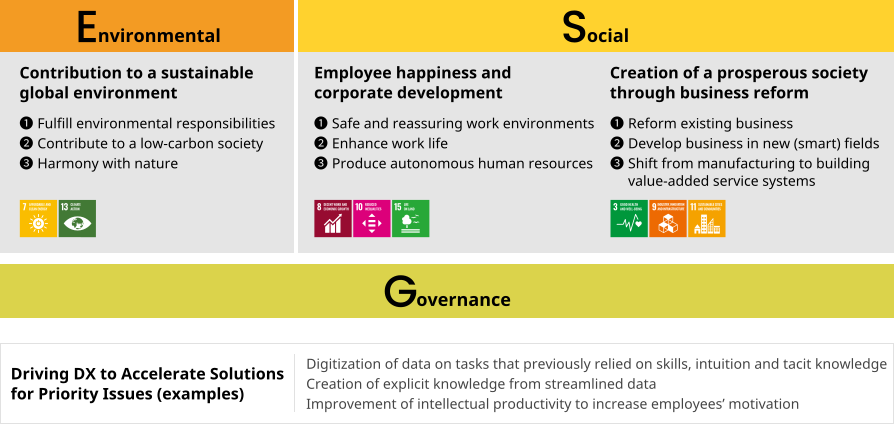
We formulated "Aichi Steel Group: Vision 2030" in 2020.
Setting forth "Enhance earnings capacity by reforming business and manufacturing capabilities while putting ESG management into practice" as our basic policy, we established three major management guidelines.
We will develop activities actively to become a leading company in ESG management, such as significantly transforming the business model mix, contributing to the global environment and the society through investment for growth, and creating a company where employees can work vigorously with motivation and pride.
In addition, we will strengthen the foundation of the company through digital transformation (DX) and accelerate our efforts.
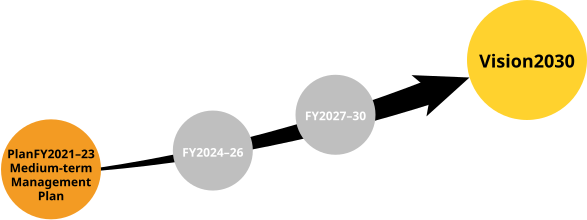
Positioning of Vision 2030 and the New Medium-term Management Plan
In February 2025, as part of the second step aimed at realizing Vision 2030, we updated the content of our FY2024-26 Medium-term Management Plan to include our specific growth strategy and finance and capital strategies.
We will always keep our antennas high in the business environment that is changing rapidly and from moment to moment, respond to changes with agility and flexibility, and steadily reach milestones toward achieving our vision.
Priority Issues (Materiality)
Basic approach
In line with Our Vision, we believe that helping to realize a sustainable society through our business activities will enhance our corporate value in the medium to long term. To realize this, we formulated a basic policy in our Vision 2030: “Enhance earning power by reforming business and manufacturing while implementing ESG management.” We have identified key issues to be addressed and set KPIs as specific goals. By working to achieve these, we aim to realize our Vision 2030 and solve social issues.
Management system
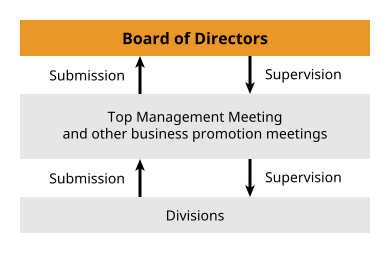
Under the leadership of the management team, Aichi Steel brings together the cross-division functions of administrative divisions and the business focus of in-house companies to drive our sustainability initiatives. The business promotion councils manage action plans and progress to ensure KPIs are achieved, and regularly report to the Top Management Meeting and Board of Directors. The Top Management Meeting carries out regular reviews based on the progress of each initiative, social trends, and changes in the business environment. After revising priority issues (materiality) and KPIs, and discussing and considering how to reflect the changes in management policy, planning, and strategy, the Top Management Meeting decides important matters through discussion with the Board of Directors.
Management system
Identification process
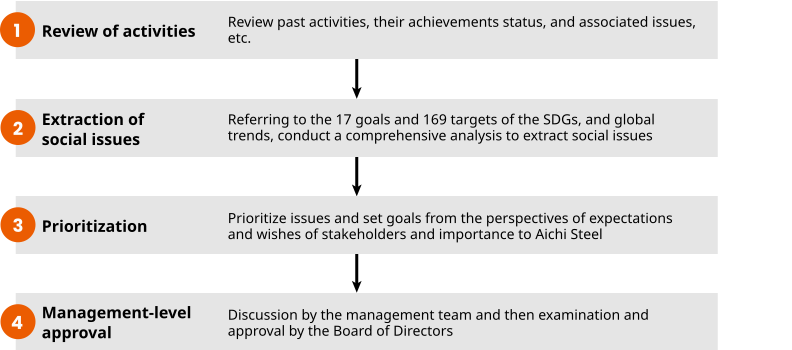
In identifying materiality, we reviewed our past activities and achievements in addressing social issues. Referring to SDG goals and emerging global challenges, we conducted internal discussions based on the demands and expectations of diverse stakeholders, including customers and shareholders, to determine what is most important for our company. We then prioritized these challenges and established targets.
Our management team then held discussions, which were followed by deliberation and approval by the Board of Directors. In terms of key indicators from the perspectives of circular manufacturing, the environment, safety, and people, we aim to enhance sustainability by promoting the resolution of critical issues for both society and our company. We will achieve this through various initiatives that involve setting KPIs and managing performance in each responsible department.
Identification process
Priority issues, main KPIs, target years, and targets
| Materiality | KPI | FY2024 results | Main initiatives | Related SDGs |
|---|---|---|---|---|
| Climate Change | CO2 emission reduction rate
|
25.4% |
|
  |
| Resource Circulation | By-product landfill volume (2,400 tons in 2026, 2,000 tons in 2030) |
2,430t |
|
  |
| Environmental Conservation | Air pollutant emissions | NOx 121 t/yr, SOx 1.47 t/yr |
|
|
| Plant effluent pollutant load | COD 8.85 t/yr, nitrogen 3.76 t/yr, phosphate 0.35 t/yr | |||
| Procurement | Green Procurement Guidelines dissemination rate (100%) | 100% |
|
|
| Number of breaches of the Subcontracting Act (0) | 0 | |||
| Technology Innovation | Number of patent applications (50/year) | 54 |
|
|
| Cybersecurity | Serious incidents due to cyberattacks (0) | 0 |
|
|
| Quality and Production | Number of defects released to customers (0) | 27 |
|
|
| Crude steel production | 956,000 tons | |||
| Forged product production | 239,000 tons | |||
| Electronic component production | 48.3 million sets | |||
| Safety and Health | Number of serious accidents (0) | 0 |
|
  |
| Lost worktime rate due to injury or sickness (0.25%) | 0.81% | |||
| Workstyles and Human Resource Development | Days of annual paid leave taken (20) | 16.4 days |
|
|
| Monthly overtime (per person, office) (10 hours) | 14.3 hours | |||
| Education time per person | 14.0 hours | |||
| Diversity | Number of female managers (10) | 6 |
 |
|
| Coexistence with Community | Volunteer activity participation rate (100%) | 80% |
|
 |
| Human Rights | Human rights education in job-specific training (100%) | 100% |
|
 |
| Legal Compliance | Serious violations of laws and regulations (0) | 0 |
|
|
- FY2024 results are non-consolidated for Aichi Steel